
Floor + Function
This week we discuss how modern living has changed our relationship with the floor, and why maintaining the ability to squat, kneel, and rise may be important for aging independently.
Have We Designed Movement Out of Our Lives?
When was the last time you sat on the floor? Not because you fell or dropped something under the couch, but because you simply chose to sit there?
In many cultures, squatting, kneeling, and floor sitting have traditionally been part of everyday life. Yet in much of modern American living, we've surrounded ourselves with chairs, couches, raised toilets, and elevated beds. We've made life more convenient, but have we also eliminated opportunities to practice movements that help us remain mobile and independent?
Just as a continuation from our knee chat from last week, check out the differences of range of motion depending on activities:
Under 90° of knee flexion: Many ordinary walking and stair-climbing movements.
127° or more: Deep squatting and kneeling.
The difference raises an important question: If our daily lives rarely ask our knees to bend deeply, how do we maintain the ability to do so?
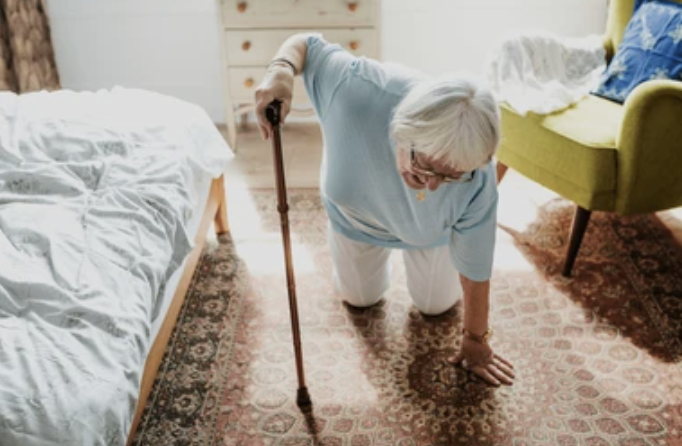
And here's where the research becomes especially interesting. In one study comparing younger and older adults, healthy older participants took approximately twice as long to rise from the floor. Among older adults living in congregate housing, 24% couldn't rise without support, and 13% couldn't rise even with support available.
Another study reported that 38% of its congregate-housing participants couldn't rise without assistance.
These findings don't prove that chair-based living caused the difficulties. But they highlight something worth considering:
Getting down to the floor and back up is a functional skill that can become more challenging as we age.
Squatting and floor transitions challenge knee & ankle mobility, hip flexibility, muscular strength, balance, sensory awareness, and coordination. When we stop practicing these movements, we may gradually lose familiarity and capacity in the very skills that support our independence.
Use It or Lose It: Reintroducing the Floor
Our bodies adapt to the movements we practice and the movements we avoid. Aging may change our capacity, but our daily habits help determine which movement skills we maintain.
This doesn't mean everyone needs to perform a deep squat or spend hours kneeling. It means we should consider whether our everyday environment provides enough opportunities to move through a variety of comfortable positions.
In today's Qi Chat, we'll explore how to reintroduce floor-oriented movement and why the knees need opportunities to bend, load, and adapt.
THREE HABITS TO EXPLORE
1. BEND | Explore Your Knee Mobility
Use a sturdy countertop for support and slowly lower into a comfortable squat. Allow your knees to travel forward naturally as your hips and ankles move. There's no need to force depth or push into pain.
2. LOWER | Change Your Sitting Habits
Consider spending a few minutes sitting on a firm cushion or mat instead of always choosing a chair. Explore different comfortable leg positions, and use support as needed. The goal is movement variety, not holding one position for long periods.
3. RISE | Practice the Skill of Getting Up
Getting to the floor is only half the challenge! With stable support and assistance when needed, practice moving between sitting, kneeling, and standing. If the floor isn't accessible yet, begin with a higher surface and gradually develop the strength and coordination to lower yourself further.
AGE TRAINING LESSON: Our bodies adapt to the movements we practice and the movements we avoid. Aging may change our capacity, but our daily habits help determine which movement skills we maintain.
Neuro-Qi Tip o’the day!
Get down!
✔ Don't let your furniture determine your mobility. Look for opportunities to explore comfortable knee, hip, and ankle movement beyond your usual sitting positions.
✔ Practice the movements you want to keep. Squatting, lowering, and rising are skills that benefit from regular, appropriately progressed practice.
✔ Make the floor an option, not an obligation. Adapt the movement to your current capacity, especially if you have knee pain, joint replacements, or balance limitations.
*Video posts every Friday by 11:30am MDT
