
Autumn Qi Chats | Week 3
Seeing + Stamina
This week we discuss how breathing and nervous system resources can influence vision, balance, and movement.
“Seeing is Believing”
We often think of vision as simply seeing what is in front of us, but your visual system is constantly providing information your brain uses to organize movement, balance, posture, and our interactions with the world around us.
Think about hearing a sudden POP! Your nervous system may immediately react to the sound, but what do you instinctively do next? You turn your head and look. Your eyes scan the environment to help your brain answer: What was that? Where did it come from? Is it important? What should I do next?
This gives us a simple way to understand how the nervous system works:
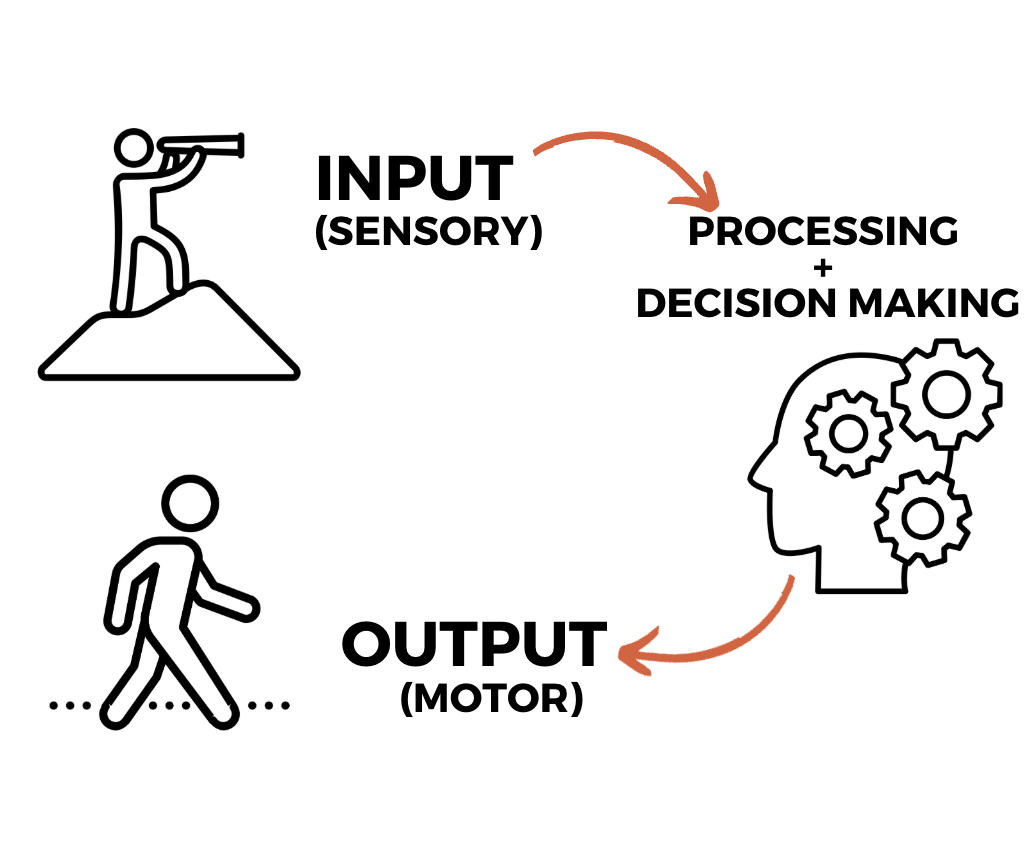
INPUT → PROCESS → OUTPUT
INPUT: Your eyes gather information from the environment.
PROCESS: Your brain interprets that information alongside your other senses.
OUTPUT: Your brain uses that information to help organize an appropriate response, whether that's turning your head, adjusting your balance, changing your posture, or moving.
And vision can have a powerful influence on how we move. As we age, changes in balance, proprioception, and vestibular function may make us rely even more heavily on what we see to feel oriented and stable.
I like to point out the mirrors in fitness studios to show how reliant we are on our eyes to confirm movement. We watch our knees during a squat, check our posture, or look to see whether our shoulders are level.
But relying on the mirror also teaches us something interesting. Take the mirror away and your brain has to rely more heavily on other sensory information, including proprioception, to determine where your body is and how it's moving.
That’s why visual training belongs in Age Training because the visual system is an important input giving those muscles information.
PROCESSING NEEDS FUEL
Have you ever caught yourself thinking, “My balance just isn't as good anymore,” “My eyes are getting older,” or “My brain just doesn't work like it used to”?
Age-related changes are real, but age isn't the only thing influencing how your nervous system performs today. Your eyes may gather the information, but your brain still has to process it, and that requires energy. Vision, balance, movement, learning and adapting all require resources, including oxygen and glucose.
This is where our Autumn focus on breathing comes in. We often assume better breathing means taking bigger breaths to get more oxygen. But your body is constantly balancing oxygen (O₂) and carbon dioxide (CO₂), and both matter to the environment in which your brain and nervous system have to function.
So more breathing isn't necessarily better breathing. We want a breathing system that can adapt to what we're asking our body to do.
And this brings us back to our eyes. Visual training doesn't happen in isolation. Your brain needs both good sensory information and the resources to process it.
Neuro-Qi Tip o’the day!
Breathe + See the difference
Assess your vision and then use these breathing drills as a recovery tool [demo in video]
Start with a baseline with vision and control pause
Move into nasal breathing & air hunger drills
*Video posts every Friday by 11:30am MDT
Resources: https://pmc.ncbi.nlm.nih.gov/articles/PMC6735527/
